
Writing equations from word problems worksheet answers are included with this free four-page practice pack. The first three pages contain 12 original word problems, and the fourth page gives the equations, solutions, units, and substitution checks. Practice turning a real situation into a one-step or two-step equation before checking the answer key.
The problems use whole-number answers and familiar situations such as shopping, sharing supplies, and paying a fixed fee. They suit learners who understand the four basic operations and are beginning to solve equations with one variable. The mixed page also uses the perimeter formula for a rectangle.
Download the worksheets and answer key PDF
What is in the printable pack?
| Page | Questions | Focus |
|---|---|---|
| 1 | 1-4 | One-step addition, subtraction, multiplication, and division equations |
| 2 | 5-8 | Two-step equations using a fixed amount and equal groups |
| 3 | 9-12 | Mixed situations, including perimeter and comparisons |
| 4 | Answers 1-12 | Equations, solutions, units, and checks |
On each student page, write what x represents before writing the equation. The answer key uses x for the unknown amount requested in each question. A different variable letter is fine if its meaning is clear.
How to write an equation from a word problem?
- Identify the unknown. State exactly what you need to find and give it a variable.
- Describe the relationship. Decide how the quantities combine. A total may include repeated equal groups, a fixed amount, or both.
- Write an equality. Put two expressions with the same value on opposite sides of the equals sign.
- Solve with inverse operations. Keep the equation balanced by doing the same operation to both sides.
- Check the result. Substitute the solution into the original equation and answer the question with a unit.
Worked example: notebooks and delivery
Three notebooks have the same price. With a $5 delivery charge, the total is $26. Let n be the price of one notebook in dollars. The notebooks cost 3n, so the equation is 3n + 5 = 26. Subtract 5 from both sides to get 3n = 21, then divide by 3 to get n = 7. Check: 3(7) + 5 = 26. Each notebook costs $7.
Notice that the delivery charge appears only once. Writing 3(n + 5) would charge delivery three times and describe a different situation. Explaining what each part represents helps prevent this kind of error.
Worksheet 1: one-step word problems
Begin with four situations that each require one operation to isolate the unknown. Read the question carefully: the first two problems ask for a starting amount, while the last two ask for a unit price and a total.
- Mia had some stickers. She received 8 more and now has 23. How many stickers did she have at first?
- Ben gave away 6 marbles and has 17 left. How many marbles did he have before giving any away?
- Four notebooks cost $28 altogether. Each notebook costs the same amount. What is the price of one notebook?
- A teacher puts the same number of pencils into 4 cups. Each cup has 9 pencils. How many pencils are there in total?
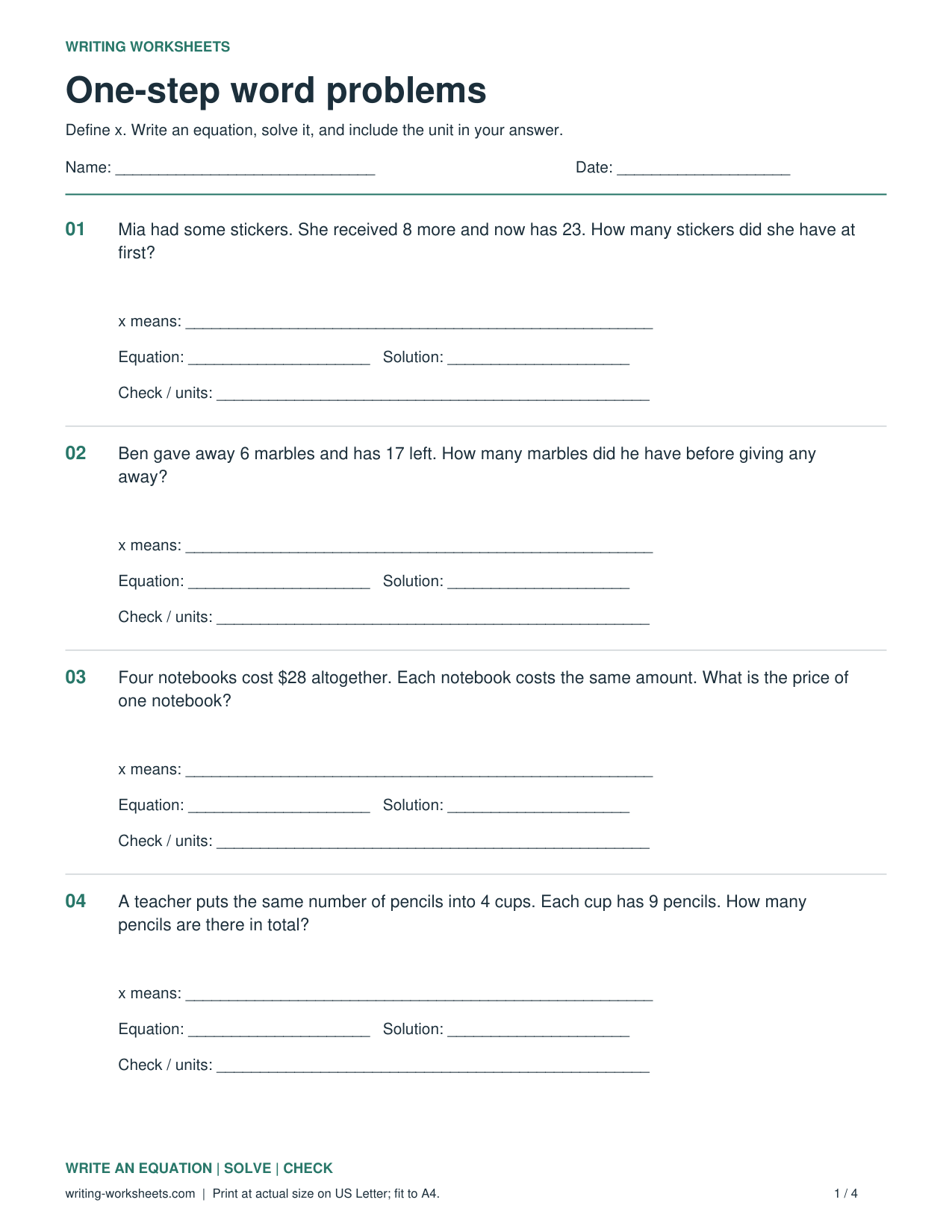
For question 4, x is the total number of pencils, so dividing x by 4 gives 9 pencils in each cup: x / 4 = 9. The equation x = 4 × 9 is also a correct representation. An equation can look different from the answer key and still describe the same relationship.
Worksheet 2: two-step word problems
These questions combine an equal-group or rate relationship with an added or removed amount. After writing the equation, identify which operation happened last in the expression and undo that operation first.
- A taxi charges a $3 starting fee plus $2 per mile. The total fare is $17. How many miles was the trip?
- Three boxes each contain the same number of pencils. After 5 pencils are removed, 22 remain. How many were in each box?
- Cards are divided equally into 5 piles. Then 2 extra cards are added to each pile, making 8 in each. How many cards were there originally?
- Four tickets have the same price. A single $6 booking fee makes the total cost $42. How much does one ticket cost?
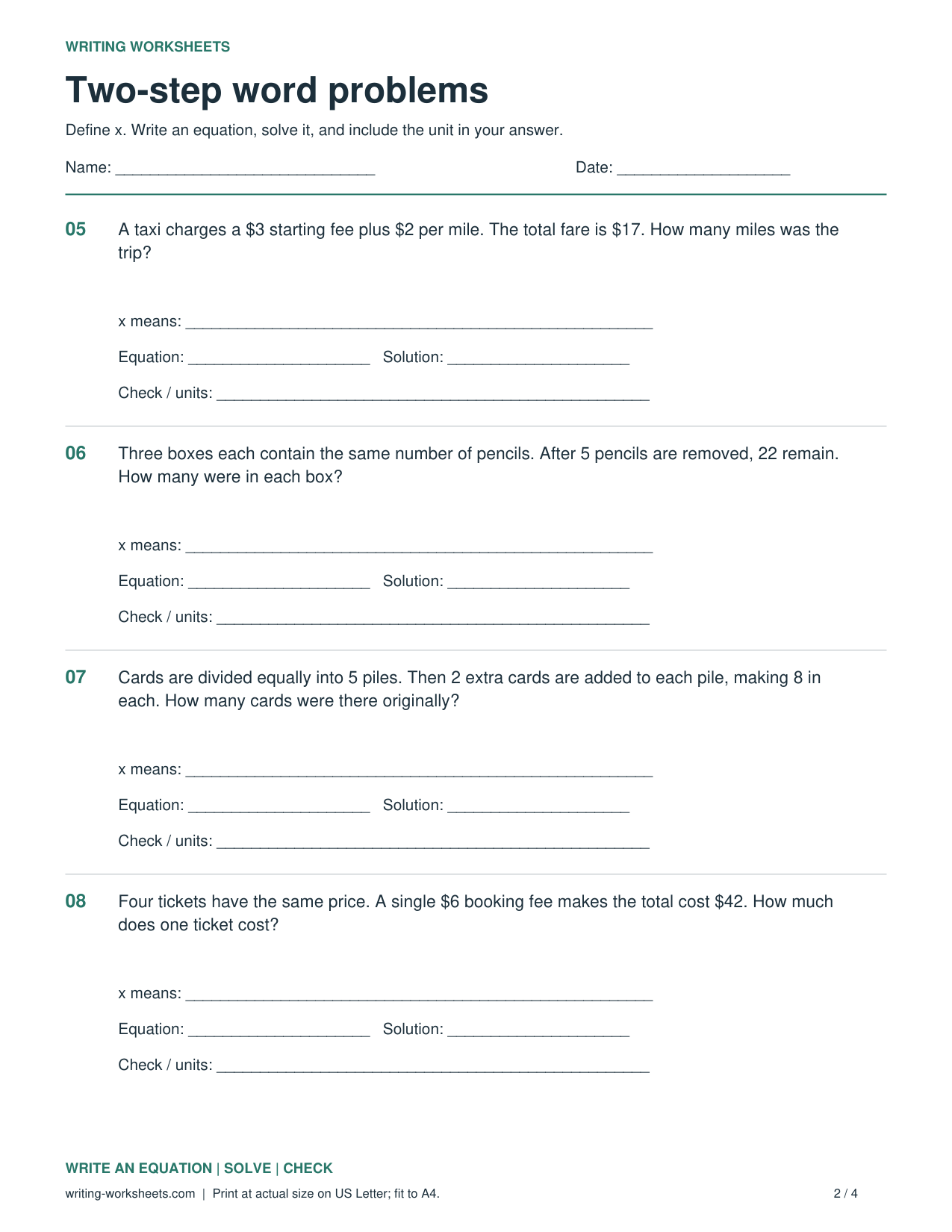
Question 7 needs particular care. The original cards are split into five equal piles before two extra cards are added to each pile. The relationship is x / 5 + 2 = 8, rather than (x + 2) / 5 = 8. Subtract 2 to find the original size of one pile, then multiply by 5 to recover the original total.
Worksheet 3: mixed word problem practice
Use the same define-write-solve-check method for the mixed set. For the rectangle, the perimeter includes two lengths and two widths. For comparisons, keep track of whose quantity the variable represents.
- A rectangle has length 12 cm and perimeter 38 cm. What is its width? Use P = 2(length + width).
- Sam has 3 more coins than twice the number Lee has. Sam has 19 coins. How many coins does Lee have?
- Five bags contain the same number of apples. After 7 apples are eaten, 18 remain. How many apples were in each bag?
- A club charges an $8 joining fee and $4 per week. A member has paid $40 in total. How many weeks have they paid for?
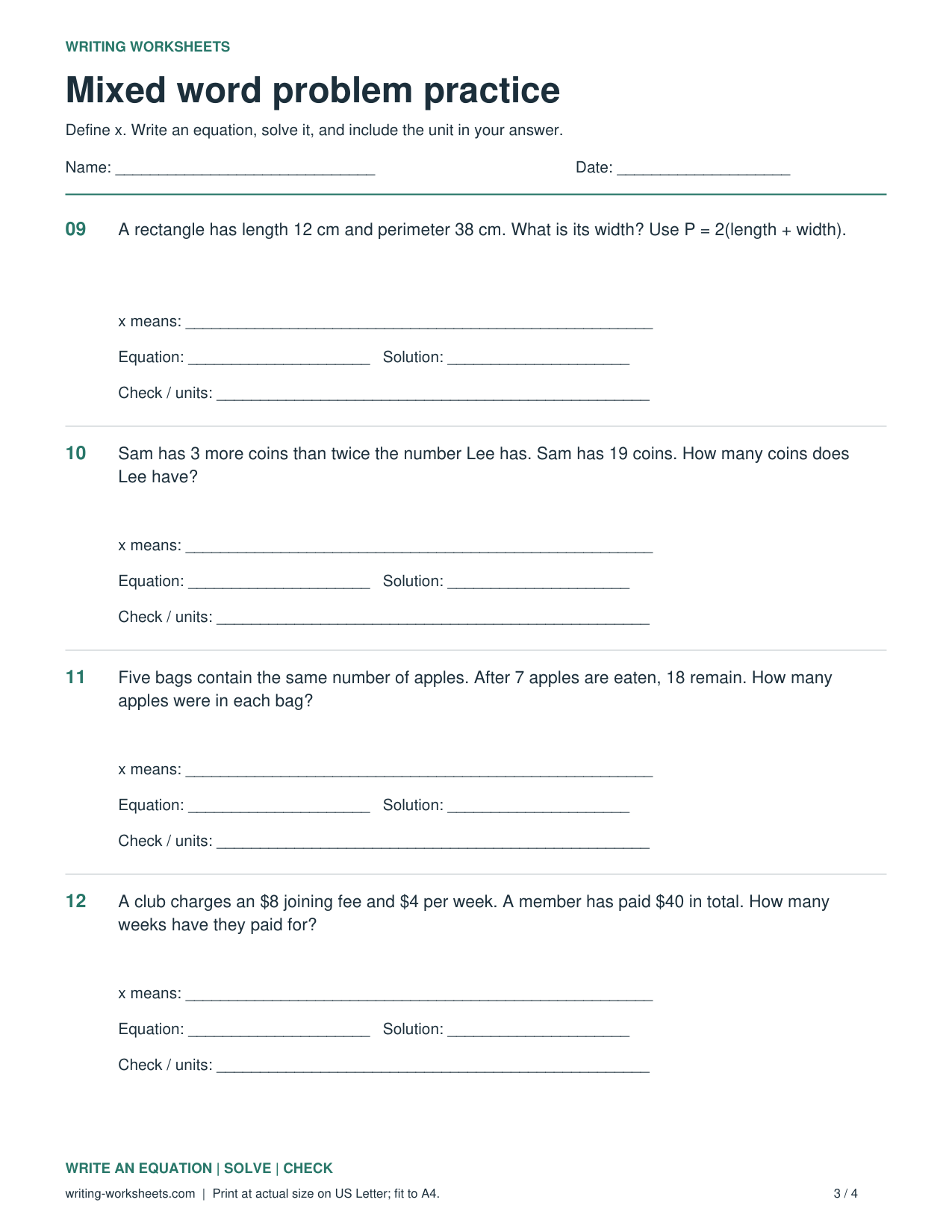
In question 10, x represents Lee’s coins. Twice that amount is 2x, and Sam’s three additional coins make 2x + 3. Since Sam has 19 coins, write 2x + 3 = 19. Solving gives x = 8, so Lee has eight coins. The final answer must identify Lee, because that is who the question asks about.
Answer key: equations, solutions, and checks
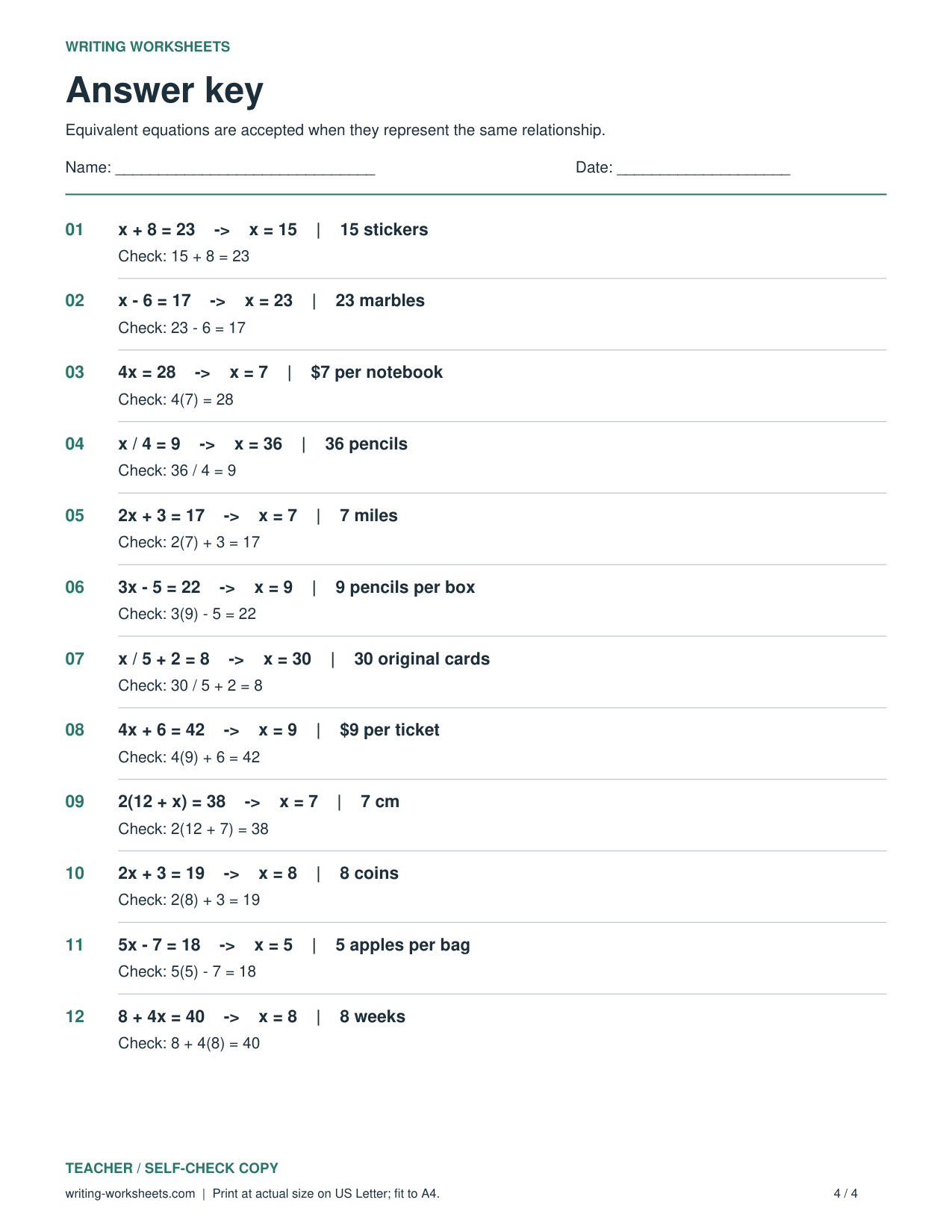
Use the table after attempting the problems. Check the equation as well as the final number: a correct number without a matching relationship may hide a misunderstanding. Accept equivalent equations when the variable definition and reasoning are valid.
| No. | Equation | Answer | Substitution check |
|---|---|---|---|
| 1 | x + 8 = 23 | 15 stickers | 15 + 8 = 23 |
| 2 | x – 6 = 17 | 23 marbles | 23 – 6 = 17 |
| 3 | 4x = 28 | $7 per notebook | 4(7) = 28 |
| 4 | x / 4 = 9 | 36 pencils | 36 / 4 = 9 |
| 5 | 2x + 3 = 17 | 7 miles | 2(7) + 3 = 17 |
| 6 | 3x – 5 = 22 | 9 pencils per box | 3(9) – 5 = 22 |
| 7 | x / 5 + 2 = 8 | 30 original cards | 30 / 5 + 2 = 8 |
| 8 | 4x + 6 = 42 | $9 per ticket | 4(9) + 6 = 42 |
| 9 | 2(12 + x) = 38 | 7 cm | 2(12 + 7) = 38 |
| 10 | 2x + 3 = 19 | 8 coins | 2(8) + 3 = 19 |
| 11 | 5x – 7 = 18 | 5 apples per bag | 5(5) – 7 = 18 |
| 12 | 8 + 4x = 40 | 8 weeks | 8 + 4(8) = 40 |
How to use the checks
A substitution check replaces the variable with the proposed solution. For question 6, substitute 9 into 3x – 5 = 22: three boxes of nine pencils give 27, and removing five leaves 22. For question 9, substitute a width of 7 cm into 2(12 + x) = 38. Two times 19 is 38, so the width fits the given perimeter.
Common mistakes to watch for
- Confusing expressions and equations: 2x + 3 is an expression; 2x + 3 = 17 is an equation that can be solved.
- Using keywords without reading the relationship: “seven less than a number” means x – 7, not 7 – x. Decide which quantity is reduced.
- Repeating a one-time fee: a single booking fee belongs outside the cost of each ticket.
- Changing only one side: subtract or divide on both sides to preserve equality.
- Leaving out units: distinguish seven dollars per notebook from seven notebooks.
Printing and lesson ideas
Print pages 1-3 for students and keep page 4 for checking. The PDF uses US Letter pages; select fit to page when printing on A4. The individual PNGs can also be opened at full size and printed. Preview the margins before making multiple copies.
For a short lesson, model one example, work through a second together, and then assign a small selection independently. Ask learners to explain one equation in words. For an extension, let them choose a solution first and write a new story that fits an equation with that solution.
Frequently asked questions
Are answers included in the PDF?
Yes. Page 4 includes answers to all 12 questions, with equations, units, and substitution checks. The same answers appear in the HTML table above.
Does every correct equation have to match the key exactly?
No. Equivalent equations are acceptable. For example, x + 8 = 23 and x = 23 – 8 both represent the first problem when x is Mia’s original number of stickers.
What should a learner practice first?
Start with identifying unknowns, the four operations, and one-step equations. Learners who need to work on translating phrases can also explore writing expressions for 5th grade before returning to the word problems.