
Free handwriting printable worksheets give learners a clear place to practice letters, words, and sentences. This four-page pack includes uppercase letters, lowercase letters, six short words, and four simple sentences. Light-gray models show what to trace, while guide lines and empty spaces make room for independent writing.
Choose one page for a short practice session at home or in class. The pack uses print-style letters rather than cursive, and it includes a PDF for printing plus individual worksheet images.
Download all handwriting worksheets as a PDF
What is included in the handwriting worksheet pack?
| Page | Practice | Main focus |
|---|---|---|
| 1 | Uppercase A-Z | Recognizing and copying capital letter shapes |
| 2 | Lowercase a-z | Letter height and placement on guide lines |
| 3 | cat, sun, dog, pen, map, hat | Joining separate letters into readable words |
| 4 | Four short sentences and an original sentence | Word spacing, capitals, and periods |
These pages are intended for beginning print handwriting practice. Select a page according to what the learner can already do: someone who is still identifying letters can start with one alphabet row, while someone who writes letters comfortably can begin with words or sentences. The worksheets are not tied to a particular school handwriting scheme.
1. Uppercase alphabet handwriting worksheet
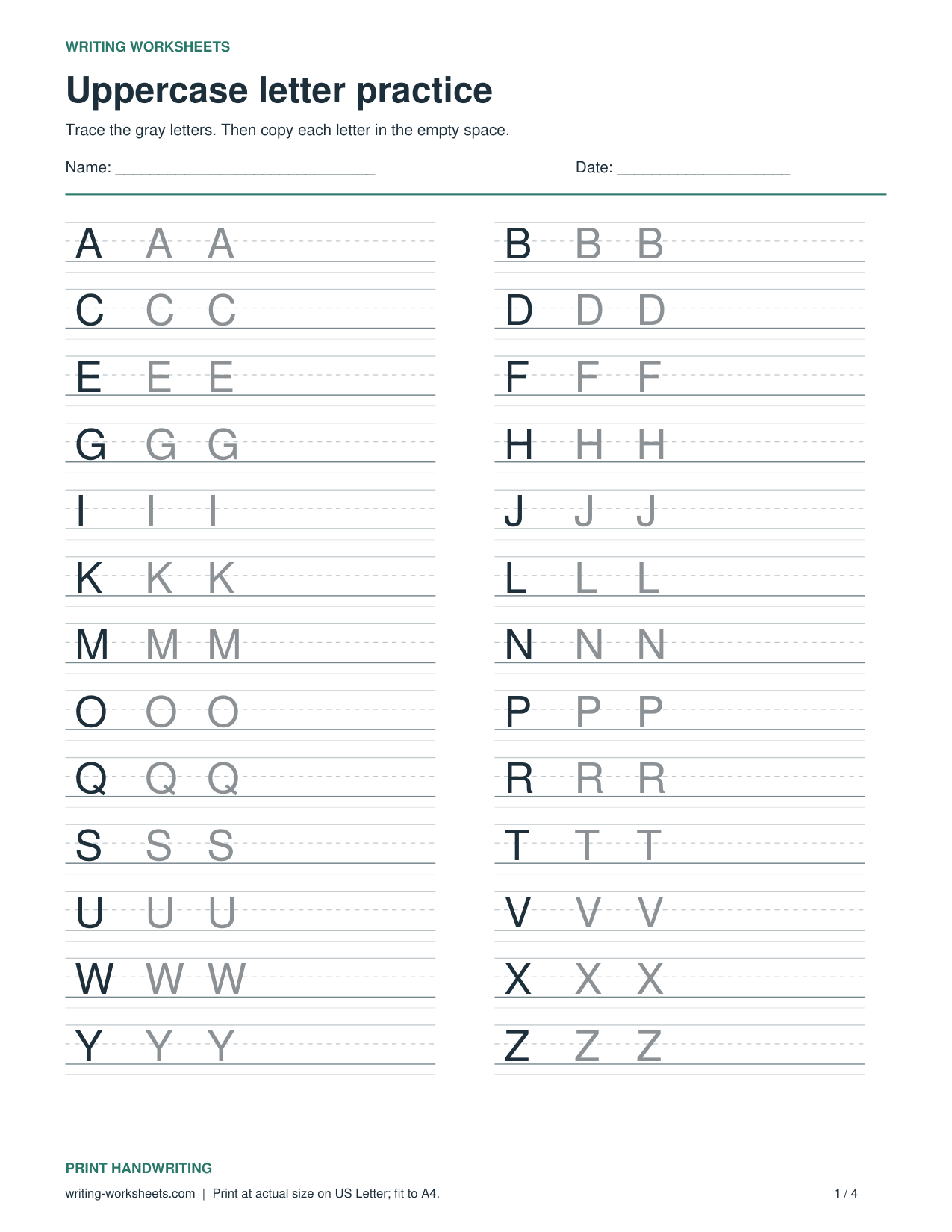
The first page covers all 26 capital letters, with two letters on each row. Look at the dark model, trace the two light-gray examples, and copy the letter in the remaining space. A learner can complete a few letter pairs at a time instead of filling the whole sheet in one sitting.
Before tracing, model the letter on separate paper and describe the movement in simple terms, such as a straight line or a curve. If the learner’s school teaches a particular stroke sequence, use that sequence alongside the printed model. This sheet does not include numbered stroke arrows.
2. Lowercase alphabet handwriting worksheet
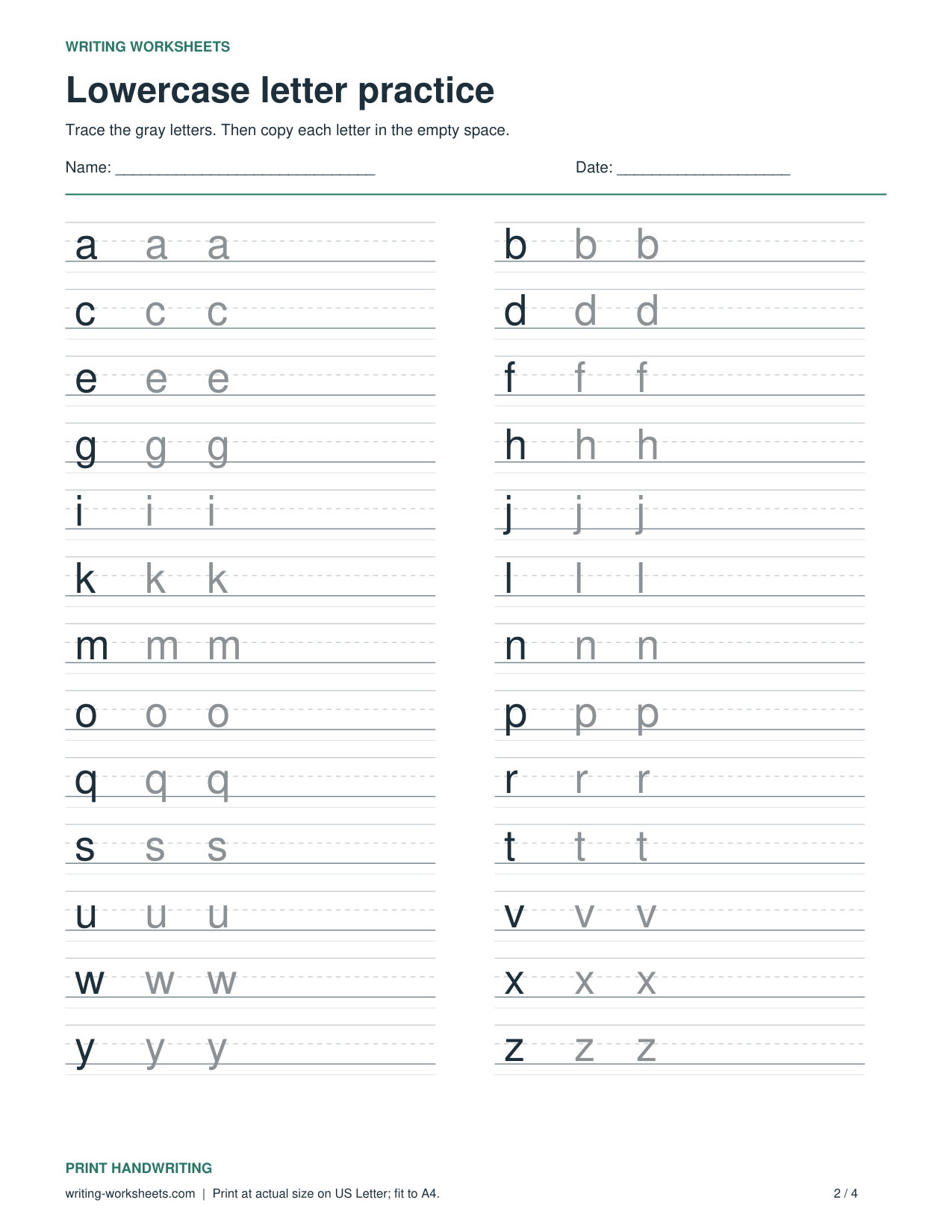
The second page presents lowercase a through z. Encourage the learner to notice how letters sit on the baseline. Some letters are short, some reach toward the upper guide, and letters such as g, j, p, q, and y extend below the baseline. The guide below the baseline leaves room for those descending strokes.
Work on a small selection of letters before completing the alphabet. For example, compare c and o, then look at the taller shapes in l and h. When two letters are easily confused, write one clear model beside the worksheet and practice that letter on its own before returning to the row.
3. Short word handwriting worksheet
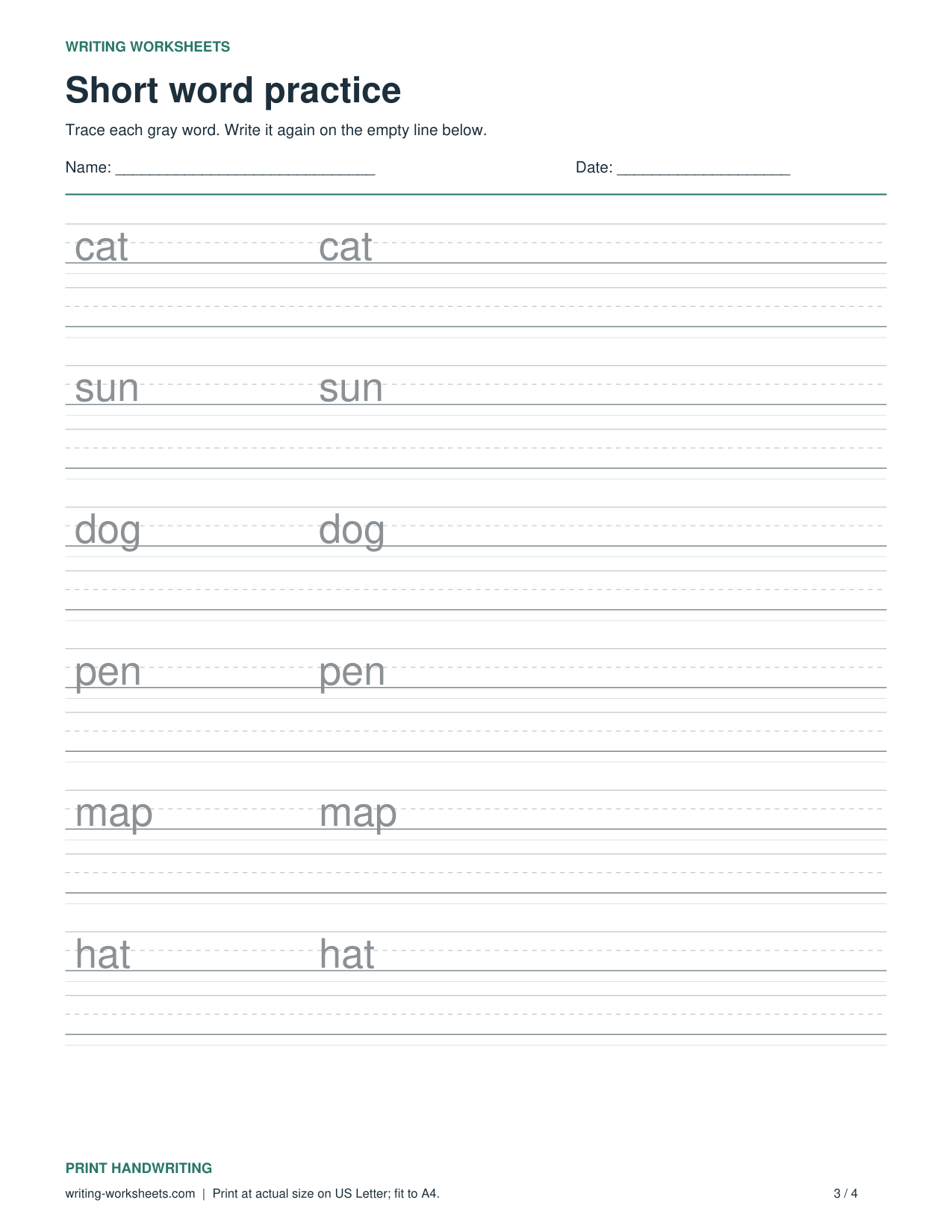
The third page uses six short words: cat, sun, dog, pen, map, and hat. Each word appears in light gray, followed by an empty practice line. Trace the word, say it aloud, and copy it underneath. Reading the model together first lets the learner focus on handwriting rather than guessing the word.
Look for letters that are crowded together or separated so widely that a word appears split. Ask the learner to choose one word that is easy to read and explain why. An optional extension is to draw a small picture of a word on a separate sheet, then write a new label without tracing.
4. Simple sentence handwriting worksheet
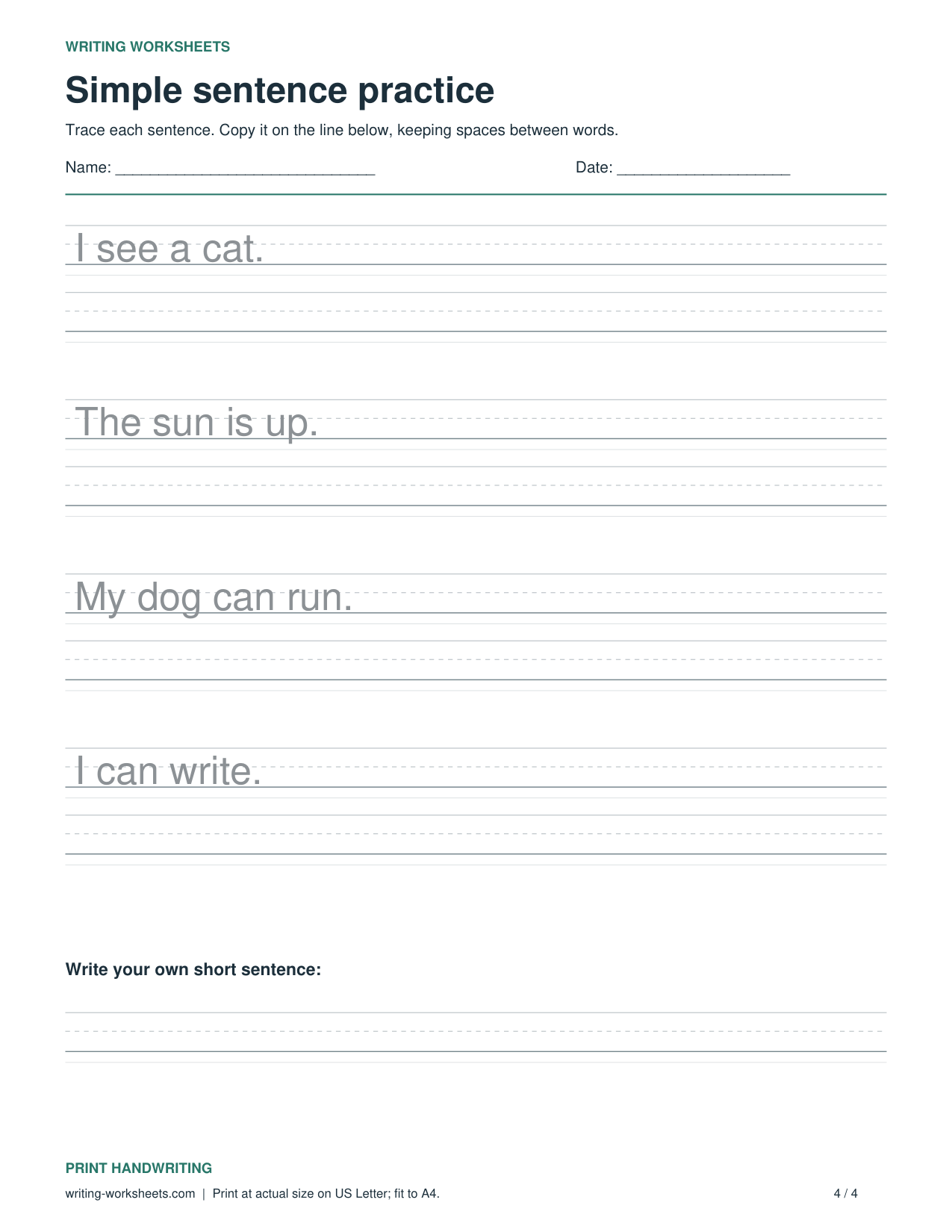
The final page includes four models: “I see a cat.”, “The sun is up.”, “My dog can run.”, and “I can write.” Trace one sentence and copy it on the line below. Use the last practice area to write an original short sentence.
Check three things after each sentence: a capital letter at the beginning, a visible space between words, and a period at the end. A small finger space or a separate spacing guide can provide a visual reminder. Keep the model visible while the learner copies; this is handwriting practice rather than a memory test.
How to print the worksheets
- Open the four-page PDF and choose the pages you want to use.
- Select US Letter paper and print at actual size, or use the printer’s fit setting for A4 paper.
- Preview the page before printing to make sure every guide line is inside the printable area.
- Use black-and-white printing. If the gray models look too faint, choose normal print quality instead of draft mode.
The PDF is the simplest option for consistent page sizing. The PNG images are useful when you want just one worksheet; open the full-size file rather than printing a small thumbnail. Print a test page before making a classroom set.
A simple handwriting practice routine
Start by choosing one target, such as keeping letters on the line or leaving spaces between words. Show an example, let the learner trace a model, and then invite an independent attempt. Compare the attempt with the model and give one specific piece of feedback. Several careful examples are more useful for reviewing that target than a page completed in a rush.
Keep paper steady and use a pencil the learner can hold comfortably. End the session when attention or comfort drops. Save a dated sample occasionally so the learner can compare their own work over time without needing to finish every page at once.
Frequently asked questions
Are these cursive handwriting worksheets?
No. All four pages use print-style lettering. For connected letter practice, browse the site’s cursive writing worksheets for left handers and choose examples that match the style being taught.
Can I use only one page?
Yes. Select a page in the PDF print dialog or open its individual PNG. You can also practice only a few rows on a page and return to the remaining rows later.
Do learners need to trace every model?
No. Tracing is a starting option. If a learner can already form the letters, use the blank spaces for independent copying and cover the model for an additional challenge.
What can I use after sentence copying?
Move to short original sentences about familiar objects or experiences. The site’s free 1st grade writing worksheets provide another writing topic to explore.